
| Verified against primary record | |
| Reporting requirement | For each group, losses and exclusions after randomisation, together with reasons[1] |
|---|---|
| Flow diagrams | Strongly recommended, with no specific, prescribed format[1] |
| Current reporting standard | A 30-item checklist, superseding the 2010 edition and renumbering the flow items[2] |
| Records read | Two guideline sources, a bias reference entry, two statistical releases, a textbook chapter and a review, 9 October 2026 |
| Independently reported | |
| Attrition bias defined | A distortion in outcomes when there are unequal losses of participants from different study groups[3] |
| Bands apply only to the rows beneath them. The 5 and 20 per cent thresholds below are described by their own source as a rule of thumb. | |
Patient attrition is the loss of participants between the start of a study and its analysis. In medical travel it is the difference between a study that can report an outcome and one that can only report who turned up, and the patients most likely to be lost are the ones whose results would change the answer.
What actually causes bias
The definition is specific, and the specificity matters: attrition bias is a distortion in outcomes in a clinical trial when there are unequal losses of participants from different study groups.[3] Unequal is the operative word. A standard epidemiology text makes the same point about cohort studies, recording that non-response, refusal to participate and withdrawals cause bias only if the degree of incompleteness differs between the groups being compared.[4]
That has a direct consequence for single-group studies, which is what most medical travel research is. A clinic following up its own patients has no comparison group, so there is no differential loss to assess. The loss is still a problem, but it is a coverage problem rather than a comparative bias, and the right question becomes who is missing rather than whether one arm lost more than another.
The thresholds, and why they are weaker than they look
A widely quoted pair of figures holds that under 5 per cent attrition leads to little bias, while over 20 per cent poses serious threats to validity.[3] It is worth knowing exactly what that is.
Three conditions travel with it. The source that states it labels it a rule of thumb rather than a standard. The same page immediately qualifies it, noting that even small proportions of patients lost to follow-up can cause significant bias. And it sits alongside a definition built on unequal losses, so a flat reading of the numbers misses the mechanism they are standing in for.[3] A claim that a study with 18 per cent loss is sound and one with 22 per cent is not misrepresents its own source.
What reporting standards require
One correction is needed before citing any of this. The 2010 trial reporting statement has been superseded. The current statement consists of a 30-item checklist of essential items, adds seven new items, revises three and deletes one, and renumbers the participant-flow items, which are now 22a and 22b rather than 13a and 13b.[2] Any article citing the 2010 numbering for participant flow is citing a superseded scheme.
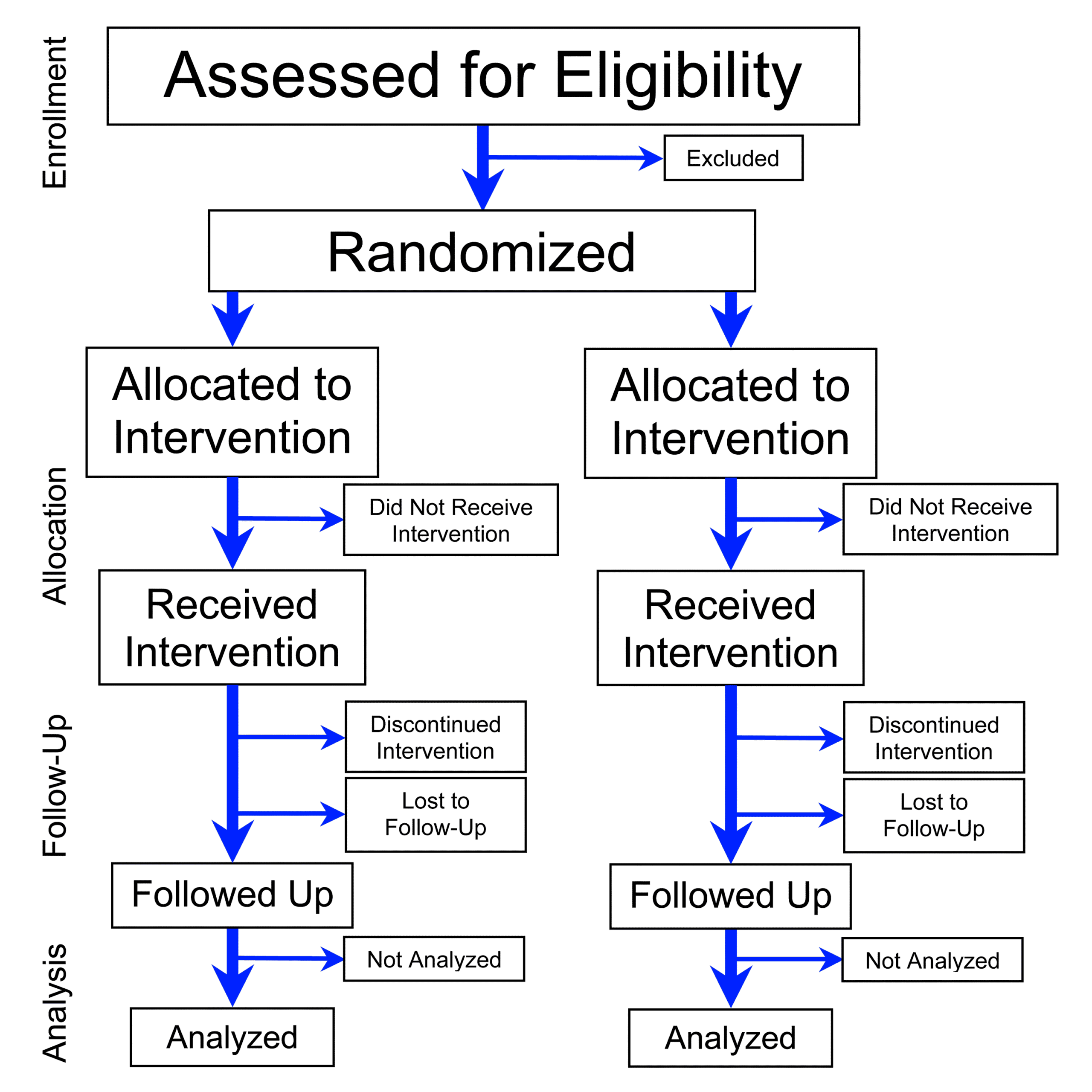
The substantive requirement is short: for each group, losses and exclusions after randomisation, together with reasons. On presentation, the guideline strongly recommends using a flow diagram to communicate participant flow throughout the study while stating that there is no specific, prescribed format. And it warns that erroneous conclusions can be reached if participants are excluded from analysis, with imbalances in such omissions between groups being especially indicative of bias.[1]
Prevention is addressed too, and in terms that bear directly on international follow-up: good communication between study staff and participants, incentives to continue, and ensuring that the study is of relevance to the participants.[3] Each of those is harder across a border, a language and a time zone.
A worked example from a funded national programme
The best available benchmark for what attrition costs comes from a mandated, funded, single-payer collection operating in patients’ own country. For hip and knee replacement in one year it reported a headline participation rate of 70.1 per cent for hips and 68.3 per cent for knees at the pre-operative stage, post-operative return rates of 63.1 and 59.4 per cent, and linkage rates of 58.0 and 59.4 per cent, leaving roughly a quarter of procedures with a complete and linked pair of questionnaires.[5]
A later provisional release for the following year reported markedly lower pre-operative participation, at 41.0 per cent for hip replacement from 73,540 procedures and 30,175 questionnaires returned, and 37.9 per cent for knee replacement from 84,575 procedures and 32,089 returned. That release carries its own caveats, noting that it covers a period where health services were affected by the pandemic and that restrictions on movement and changes to behaviours may have affected response levels, and it withheld its score comparison tool for want of sufficient data to make meaningful comparisons.[6]
The two sets of figures are not presented here as a trend, since they come from a finalised and a provisional release with different caveats. Taken either way, the point stands: the strongest collection of this kind loses a large share of its denominator at the first step. Any claim that a destination clinic achieved near-complete follow-up of international patients should be read against that.
Attrition reporting failures inside this literature
Denominator discipline is imperfect even in commissioned evidence reviews in this field. One 2026 review reports its patient total as 650 in its discussion and 655 elsewhere in the same document, and notes of its own included studies that complications were not clearly reported and that retrospective case series and case reports are at high risk of bias due to missing information in the records.[7] The discrepancy is small and the review is candid about its material; it is noted because a reader cannot verify a rate whose denominator moves.
See also
- Missing data in medical tourism research, what to do about the gaps attrition leaves
- Selection bias in medical tourism research, loss before recruitment rather than after
- Patient-reported outcome measures, the programme the worked example comes from
- Long-term outcomes of medical tourism, attrition over longer horizons
References
- EQUATOR Network. CONSORT item 22b, participant flow, losses and exclusions, with the companion item page for participant flow numbers. Citing Hopewell S et al., CONSORT 2025 explanation and elaboration, BMJ 2025;389:e081124, 14 April 2025. Verified against primary record: official guideline repository item pages opened and read. Retrieved 9 October 2026.
- Hopewell S, Chan AW, Collins GS, Hrobjartsson A, Moher D, Schulz KF, et al. CONSORT 2025 statement, updated guideline for reporting randomised trials. BMJ 2025;389:e081123, published 14 April 2025. Independently reported: author-accepted manuscript read in an institutional repository. Retrieved 9 October 2026.
- Catalogue of Bias Collaboration, Bankhead C, Aronson JK, Nunan D. Attrition bias. Catalogue of Bias, 2017. Independently reported: academic reference resource opened and read, including its own description of the thresholds as a rule of thumb. Retrieved 9 October 2026.
- dos Santos Silva I. Cancer Epidemiology, Principles and Methods, chapter 13. International Agency for Research on Cancer, 1999. Verified against primary record: chapter opened and read on the agency’s publications site. Retrieved 9 October 2026.
- NHS England Digital. Finalised PROMs, hip and knee replacement procedures, April 2021 to March 2022, patient engagement. Published 13 July 2023. Verified against primary record: participation, return and linkage rates read. Retrieved 9 October 2026.
- NHS England Digital. PROMs, hip and knee replacement procedures, April 2022 to March 2023, provisional. Published 13 July 2023. Verified against primary record: procedure counts, returns, participation rates and the publication’s own caveats read. Retrieved 9 October 2026.
- England C, Bromham N, Needham-Taylor A, Hounsome J, Gillen E, Ingram BJ, Davies J, Edwards A, Lewis R. Complications and costs to the UK National Health Service due to outward medical tourism for elective surgery, a rapid review. BMJ Open, 2026;16(1):e109050; preprint at medRxiv 10.1101/2025.04.02.25325086. Independently reported: publicly commissioned review, preprint full text read. Retrieved 9 October 2026.
Sourcing note: the two guideline sources, the bias reference entry, the epidemiology chapter, the two statistical releases and the review were opened and read on 9 October 2026. The 5 and 20 per cent thresholds are reproduced only with the qualifications printed on the same page, because they are routinely quoted as a standard. The two years of participation figures come from a finalised and a provisional release with different caveats and are not presented as a trend. The participant-flow item numbers are those of the 2025 statement, which supersedes the 2010 numbering.