
| Verified against primary record | |
| Autonomy | None. The device regulator states the system cannot perform surgery without direct human control; the surgeon operates it from a console[1] |
|---|---|
| Cancer outcomes | Clearances for cancer-related procedures rest on 30-day follow-up; survival and recurrence have not been established, and no device is authorised to prevent or treat cancer[1] |
| Training oversight | The regulator does not supervise or accredit surgeon training; manufacturers, physicians and facilities are responsible[1] |
| Independently reported | |
| Against laparoscopic surgery | Similar conversion, complications, margins, bladder and sexual function, and three-year recurrence and survival, at roughly 1,000 pounds more per patient[2] |
| Bands apply only to the rows beneath them. The classification places robot-assisted surgery under computer-assisted surgery, not under minimally invasive surgery, so it is a control modality rather than an access modality. | |
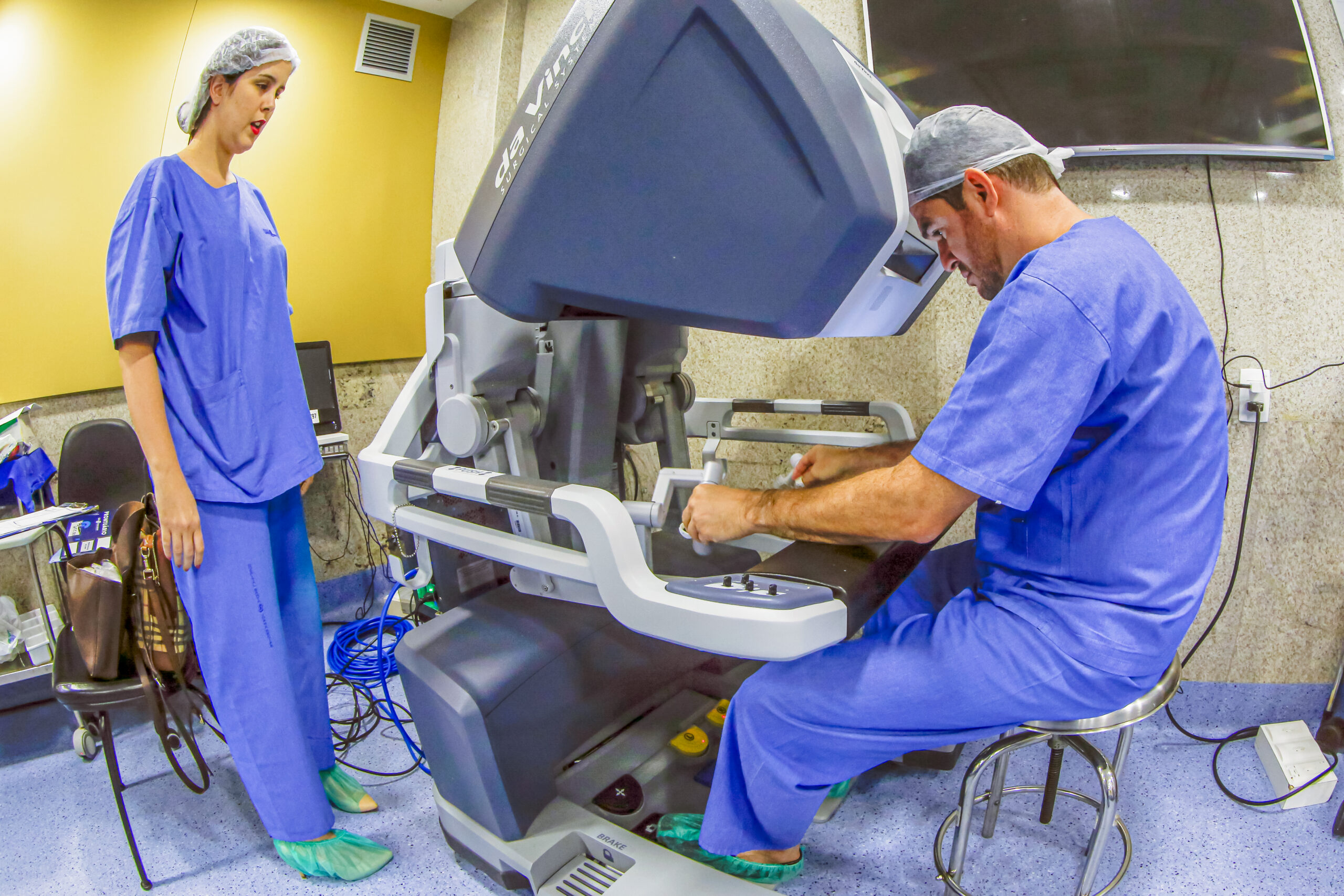
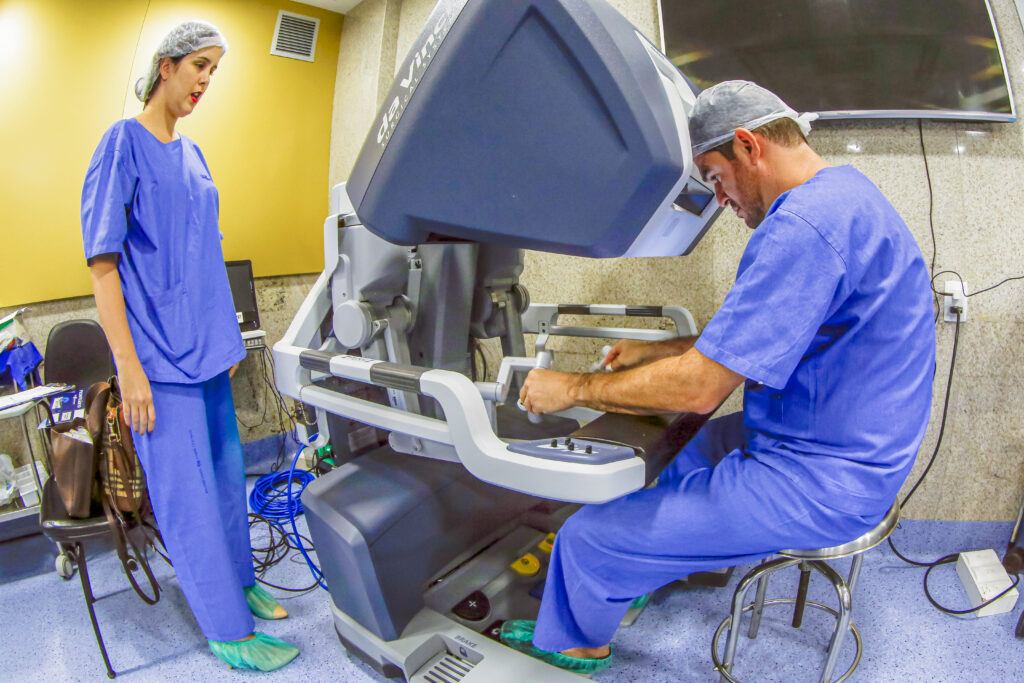
Robot-assisted surgery is surgery in which the surgeon operates instruments on mechanical arms from a console rather than holding them directly. The robot does not decide anything and does not act on its own, and the device regulator says so in terms.
Not a robot in the sense the word suggests
The device regulator’s position is unambiguous. It states that a robotically-assisted surgical device is not actually a robot, because it cannot perform surgery without direct human control; the surgeon sits at a console, views the field through a three-dimensional endoscope and controls the instruments. It has cleared such devices for trained physicians for laparoscopic procedures in general, cardiac, colorectal, gynaecologic, head and neck, thoracic and urologic surgery. It has not authorised any such device for the prevention or treatment of cancer. Clearances for cancer-related procedures such as hysterectomy, prostatectomy and colectomy rest on 30-day patient follow-up, and cancer outcomes such as survival and recurrence have not been established. No authorisation exists for mastectomy. And the regulator does not supervise or accredit physician training: manufacturers, physicians and facilities are responsible, and facilities should confirm training on each device model.[1]
Any claim that a procedure is performed by a robot, or driven by artificial intelligence, is contradicted by that statement. The honest description is a surgeon-controlled instrument-manipulation platform with no authority to act independently.
Where it sits in the classification
The indexing vocabulary places robotic surgical procedures under computer-assisted surgery, a separate branch of the operative tree from minimally invasive surgical procedures, and cross-lists them under robotics in the technology tree; its scope note describes procedures carried out remotely by a computer controlling surgical instruments on mechanical arms that perform the surgeon’s tasks, and it folds robotic surgery, robot-assisted surgery and robot-enhanced surgery into a single descriptor introduced in 2015.[3] The parent category is computer-assisted surgery, whose entry terms include image-guided surgery and surgical navigation.[4]
Two consequences. The marketing distinction between robotic and robot-assisted has no basis in the taxonomy, which treats them as one thing. And robotics is a control and instrumentation modality rather than an access modality: a robot can be used to perform a laparoscopic operation, and the robot is not what makes the operation minimally invasive.
What the trial evidence shows
The best comparison available is a multicentre randomised trial in rectal cancer surgery. Robotic surgery was not technically easier than laparoscopic, with conversion to open surgery at 8.1 per cent against 12.2 per cent, a difference that was not statistically significant. Secondary outcomes, including complications, margin status, bladder and sexual function and three-year recurrence and survival, were similar. The robotic approach cost roughly 980 to 1,000 pounds more per patient, from longer operating time and instrument costs, and the authors concluded that the extra cost is not supported for this use and that robotic surgery may not be cost-effective.[2]
Adoption has nonetheless risen quickly. A national bowel cancer audit records the robotic-assisted share of resections rising from 6 per cent in 2021 to 22 per cent in 2024, within an overall minimally invasive share of 77 per cent; the same audit folds laparoscopic and robotic together into a single minimally invasive category with one target, rather than treating them as a quality ladder.[5] Set beside the trial result, that is adoption running ahead of demonstrated advantage, with both sides of the statement sourced.
How to read a provider’s robotic claim
Three checks follow from the sources above. Whether the specific procedure is one for which the device has been cleared, since clearance is procedure-specific and does not extend to preventing or treating cancer. Whether any outcome claim beyond 30 days is being made, since the regulator states that survival and recurrence outcomes for cancer-related use have not been established. And who trained the surgeon on that particular device model, since no regulator supervises or accredits that training and the facility carries the responsibility for confirming it.
One caution about how far the regulator’s position can be pushed. What is established is that it has authorised these devices for specified procedures, has not authorised them for preventing or treating cancer, and states that cancer outcomes are not established. A safety communication specifically addressing use in women’s health and cancer-related surgery was issued in February 2019 and could not be opened during this work, so no statement is attributed to it here, and the regulator should not be described as having warned against marketing claims on the basis of what was read.
The operating microscope comparison is instructive on how little regulatory status tracks the marketing idea of advancement: the instrument that defines microsurgery is in the lowest device risk class and is exempt from premarket notification,[6] while robotic systems required premarket clearance. Advanced technique and heavily regulated technology are different axes.
No aviation or thrombosis guidance was located that distinguishes robot-assisted from laparoscopic access for the purpose of travel timing, so the flight-deferral material in the entry on laparoscopic surgery should not be read as applying differently here.[7]
See also
- Laparoscopic Surgery, the comparator in the trial evidence and the access route the robot is used for
- Minimally Invasive Surgery, the category robot-assisted surgery is not classified inside
- Microsurgery, where the defining instrument sits in the lowest device risk class
- Medical Tourism Rankings, on other technology claims used as markers of standing
References
- United States Food and Drug Administration, Center for Devices and Radiological Health. Computer-assisted surgical systems. Page published and last modified 24 September 2026. Verified against primary record: the page was opened and the statements on human control, the cleared procedure areas, the absence of a cancer authorisation, the 30-day follow-up basis, the absence of a mastectomy authorisation and the position on training read. Retrieved 10 October 2026.
- National Institute for Health and Care Research. Robotic surgery for rectal cancer produces similar results to keyhole surgery. 26 November 2019, summarising a trial reported in Efficacy and Mechanism Evaluation 2019;6(10). Verified against primary record: the summary was opened and the conversion result, the secondary outcomes, the cost difference and the authors’ conclusion read. Retrieved 10 October 2026.
- United States National Library of Medicine. Medical Subject Headings descriptor Robotic Surgical Procedures (D065287). Introduced 2015, last revised 22 July 2020. Verified against primary record: the descriptor record was opened and its scope note, its two tree positions and its entry terms read, establishing that it is not placed under minimally invasive surgical procedures. Retrieved 10 October 2026.
- United States National Library of Medicine. Medical Subject Headings descriptor Surgery, Computer-Assisted (D025321). Introduced 2002, last revised 9 June 2020. Verified against primary record: the descriptor record was opened and its single tree number and entry terms read, establishing it as the parent of robotic surgical procedures. Retrieved 10 October 2026.
- Healthcare Quality Improvement Partnership, National Cancer Audit Collaborating Centre and Royal College of Surgeons of England. Bowel cancer: State of the Nation Report 2026, National Bowel Cancer Audit. Published 8 October 2026. Verified against primary record: the report was opened and the robotic-assisted shares for 2021 and 2024, the overall minimally invasive share and the audit’s combined definition read. Retrieved 10 October 2026.
- Office of the Federal Register. 21 CFR 878.4700, surgical microscope and accessories. Current edition. Verified against primary record: the section was opened and the device identification, its class and its premarket-notification exemption read. Retrieved 10 October 2026.
- United Kingdom Civil Aviation Authority, Aviation Health Unit. Guidance for health professionals: surgical conditions. No publication or review date stated on the page. Verified against primary record: the page was opened and searched for any reference to robot-assisted surgery, which it does not mention. Retrieved 10 October 2026.
Sourcing note: a safety communication of 28 February 2019 addressing these devices in women’s health and cancer-related surgery is referred to on the regulator’s current page but could not be opened during this work, so no content is attributed to it and the regulator is not described as having cautioned about marketing claims. The trial evidence is reported through a national evidence summary rather than from the underlying report, which is recorded in its reference. No source was located establishing better outcomes for robot-assisted surgery over laparoscopic surgery in the indication studied.