
| Verified against primary record | |
| France | A thermal cure is fixed at 18 days of actual treatment and must be prescribed[1] |
|---|---|
| Reimbursement | Medical surveillance at 70 per cent and thermal treatment at 65 per cent of the conventional tariff[1] |
| Frequency | One cure per calendar year for the same condition[1] |
| Heritage listing | Eleven towns across seven countries inscribed in 2021[2] |
| Independently reported | |
| Evidence position | A 2023 review of 17 studies found 15 at medium or high risk of bias and did not pool them[3] |
| Bands apply only to the rows beneath them. The French monetary figures are current-year tariff values and will go stale; the structural rules are durable. | |
Thermal tourism is travel to take the waters: treatment using natural mineral or thermal spring water, known as balneotherapy or, in several European countries, as a thermal cure. It is the oldest form of health travel in continuous practice and the only sector covered on this site that a national health insurance system pays for on a doctor’s prescription.
A prescribed course, not a spa break
The French statutory health insurance system treats a thermal cure as a medical episode with fixed parameters. The duration is set at 18 days of actual treatment. The cure must be prescribed, by a general practitioner, a specialist or a dentist. It is available across twelve defined therapeutic orientations, including rheumatology, dermatology, respiratory conditions, digestive disorders, urinary disorders, gynaecology, phlebology, neurology, cardio-arterial disease, affections of the mucous membranes, psychosomatic conditions and child development disorders.[1]
Reimbursement follows the ordinary logic of the system. Medical surveillance is reimbursed at 70 per cent on a basis of 28 euro per consultation for the primary orientation, and the thermal treatment itself at 65 per cent of the conventional tariff. Travel and accommodation are reimbursed subject to a means test: travel at 55 per cent on the basis of a second-class return rail fare, and accommodation at 65 per cent of a flat rate of 150.01 euro, being 97.50 euro, where income for the preceding year does not exceed 14,664.38 euro, increased by half as much again for a spouse and for each dependant. Only one cure is granted per calendar year for the same condition.[1]
Those monetary figures are administrative values that change annually and should be dated wherever used; the structural rules, being the 18 days, the prescription requirement, the twelve orientations and the annual limit, are durable. Together they mark the distinction this entry turns on. A prescribed cure with a fixed duration, defined indications, an annual cap and partial state reimbursement is not the same thing as a spa break, whatever the setting they share.
Whether other systems reimburse thermal cures was not verified for this entry, and no country other than France is described here as doing so.
The heritage of the spa towns
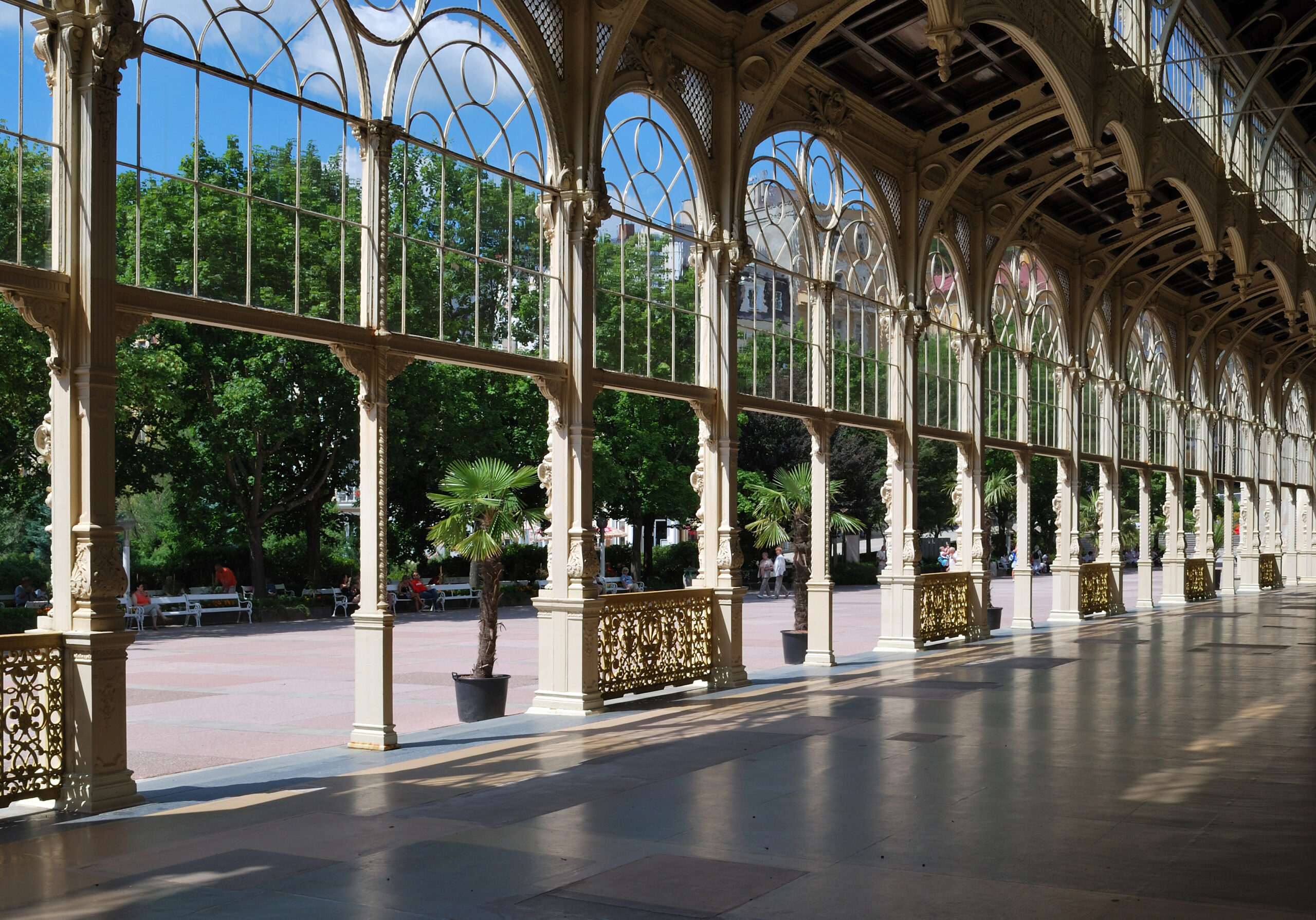
In 2021 UNESCO inscribed The Great Spa Towns of Europe on the World Heritage List under criteria two and three, a transnational serial property comprising eleven towns across seven countries: Baden bei Wien in Austria; Spa in Belgium; Frantiskovy Lazne, Karlovy Vary and Marianske Lazne in Czechia; Vichy in France; Bad Ems, Baden-Baden and Bad Kissingen in Germany; Montecatini Terme in Italy; and the City of Bath in the United Kingdom. The towns developed around natural mineral water springs and represent the international European spa culture that developed from the early eighteenth century to the 1930s, with the inscription citing significant interchange of human values and developments in medicine, science and balneology.[2]
That is a cultural heritage designation and is frequently marketed as though it were a health endorsement. The reference to developments in medicine and balneology is historical, describing what the towns represent between 1700 and the 1930s.
The evidence, stated neutrally
A 2023 systematic review of balneotherapy for osteoarthritis included 17 studies, 16 of them controlled trials and one uncontrolled. It assessed 7 as carrying a high risk of bias, 8 medium and 2 low, and performed no meta-analysis because the studies covered different anatomical sites and used different methodological approaches. Its authors conclude that the quality of many studies was not high and that new trials using more rigorous methods and statistical treatment are needed.[3]
The honest position is therefore neither that balneotherapy is proven nor that it has been disproven, but that the literature assessing it was judged methodologically weak by its own reviewers. Blinding is intrinsically difficult for a bathing intervention. The review covers osteoarthritis only and should not be extended to other indications.
See also
- Wellness tourism, the category this is most often confused with
- Medical spa tourism, the modern commercial form of the same setting
- Rehabilitation abroad, where a prescribed course and a leisure product are similarly conflated
- Traditional medicine tourism, another long-established therapy with a contested evidence base
References
- Assurance Maladie, France. Effectuer une cure thermale: formalites et prise en charge. Verified against primary record: national health insurance page opened and read. Monetary values are current-year tariff figures. Retrieved 30 September 2026.
- UNESCO World Heritage Centre. The Great Spa Towns of Europe. Reference 1613, inscribed 2021 under criteria (ii) and (iii). Verified against primary record: World Heritage List entry opened and read. Retrieved 30 September 2026.
- Balneotherapy for osteoarthritis: a systematic review. Rheumatology International, 2023. Independently reported: peer-reviewed systematic review. Retrieved 30 September 2026.
Sourcing note: the French health insurance page, the World Heritage entry and the systematic review were opened and read on 30 September 2026. The French monetary values are flagged as current-year tariff figures that will go stale, while the structural rules are durable. Germany and Hungary are often said to reimburse thermal cures; no source for either was opened and neither is described here as doing so. The heritage inscription is identified as a cultural designation, because it is routinely presented as a health endorsement. The evidence position is reported as the reviewers themselves assessed it.